
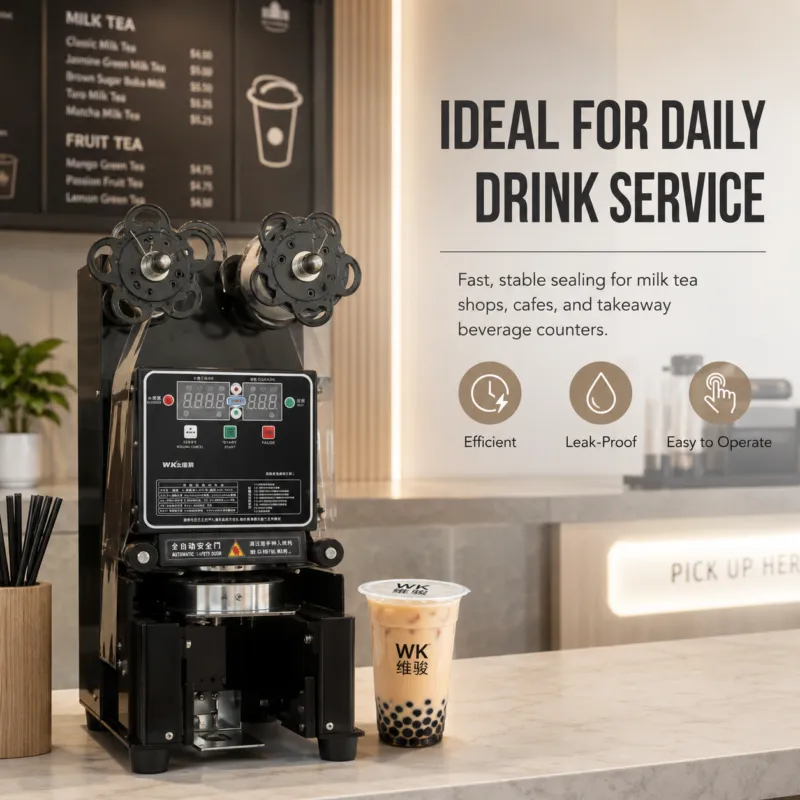
A commercial automatic cup sealing machine helps bubble tea shops, milk tea stores, cafés and takeaway beverage businesses seal compatible drink cups quickly and consistently. This guide covers the working principle, product specifications, cup and film compatibility, operation, cleaning, maintenance and buying considerations.
Why Beverage Shops Use a Commercial Automatic Cup Sealing Machine
Faster and More Consistent Takeaway Drink Packaging
Build a faster and more organised takeaway drink packaging workflow with automatic film feeding, adjustable temperature control and repeatable sealing cycles for compatible beverage cups.
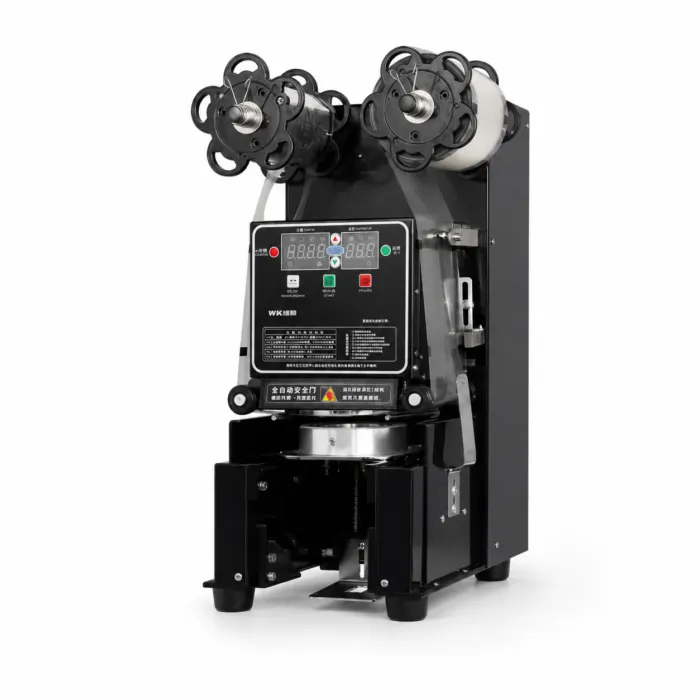
Commercial Cup Sealing Machine Guide at a Glance
Why Reliable Cup Sealing Matters for Takeaway Drinks
A commercial automatic cup sealing machine is an important packaging solution for beverage businesses that prepare a large number of takeaway drinks. After a compatible cup is placed in the holder, the machine feeds the sealing film, applies heat and pressure, cuts the film and completes the sealing cycle according to its operating settings.
Compared with manually fitting plastic lids or operating a basic manual sealer, an automatic model can reduce repeated hand movements and create a more organised packaging process. This is particularly useful when several employees work on different shifts or when a shop receives many orders during peak periods.
A secure seal can help reduce accidental leakage during handling, takeaway service and delivery. However, the final result depends on correct cup dimensions, cup-rim condition, film material, temperature, pressure and machine setup.
1. What Is a Commercial Automatic Cup Sealing Machine?
A commercial automatic cup sealing machine is a countertop packaging device that seals compatible drink cups with heat-sealing film. The machine automatically manages the main sealing cycle after the operator loads a cup and starts the machine.
The sealing film is installed on the upper film holders. During operation, the machine advances the film, positions it over the cup, presses the heated sealing plate onto the cup rim and cuts the film to complete the package.
This type of equipment is commonly used for bubble tea, milk tea, fruit tea, juice, smoothies, iced coffee, yogurt drinks and other takeaway beverages served in compatible plastic cups.
2. How Does a Commercial Automatic Cup Sealing Machine Work?
The film roll is mounted on the upper film holder and threaded through the guide rollers according to the machine instructions.
The operator selects an initial sealing temperature suitable for the cup and film combination, then allows the machine to preheat.
The cup is positioned upright in the correct holder. The cup rim must be clean, dry and free from drink residue.
The machine moves the cup into position, feeds the film and applies heat and pressure to seal the cup.
After sealing, the machine cuts the film and advances the roll for the next cup.
Check that the film is smooth, centred and completely attached around the full cup rim before serving or packing the drink.
3. Commercial Automatic Cup Sealing Machine Specifications
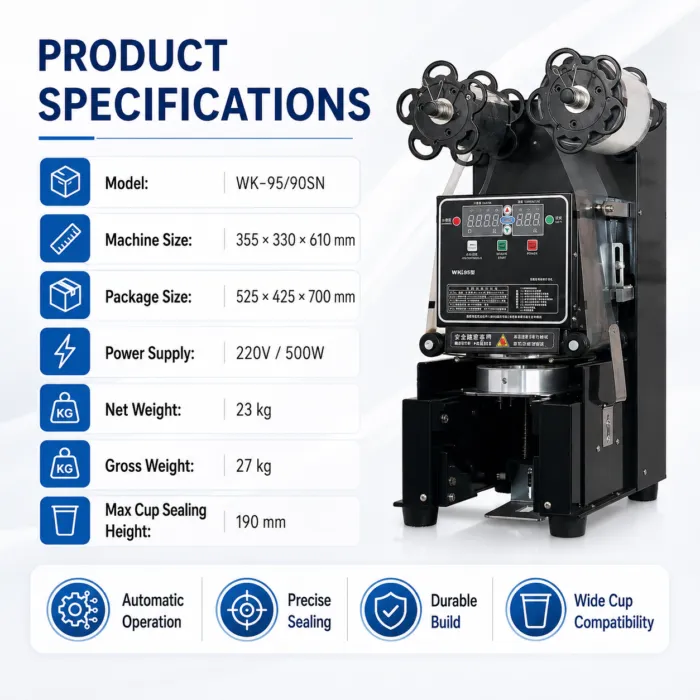
| Product Name | Commercial Automatic Bubble Tea Cup Sealing Machine |
|---|---|
| Model | WK-95/90SN |
| Machine Size | 355 × 330 × 610mm |
| Package Size | 525 × 425 × 700mm |
| Power Supply | 220V / 500W |
| Net Weight | 23kg |
| Gross Weight | 27kg |
| Maximum Cup Sealing Height | 190mm |
| Available Colours | Black and White |
| Cup Diameter and Film Material | Confirm according to the final cup holder, cup material and sealing-film configuration before ordering. |
| Recommended Applications | Bubble tea shops, milk tea shops, cafés, juice bars, restaurants, takeaway counters and beverage kiosks |
Voltage, plug type, cup holder, film width, compatible cup diameter and other machine details should be confirmed according to the destination country and final order configuration.
View the current model on the commercial automatic bubble tea cup sealing machine product page .
4. Key Advantages of a Commercial Automatic Cup Sealing Machine
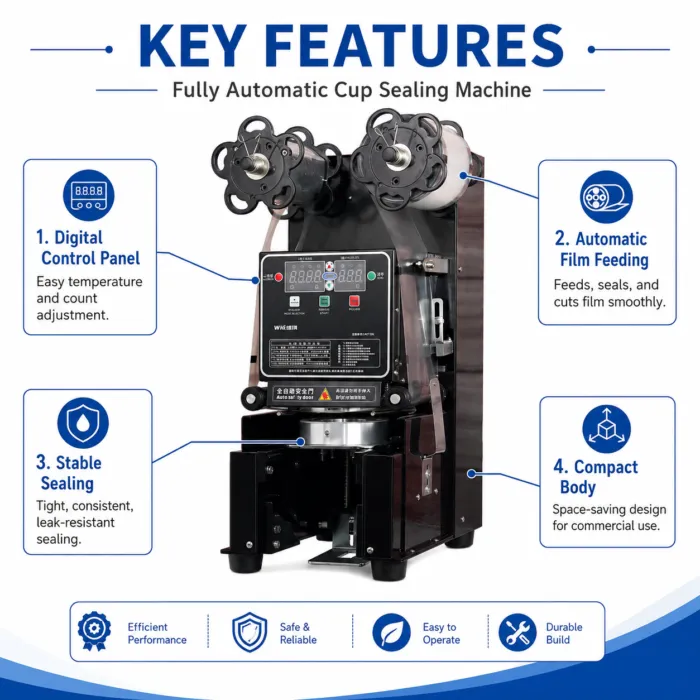
The machine advances the film automatically, reducing repeated manual film positioning during daily service.
The control panel allows the operator to adjust the heating temperature for different compatible cup and film combinations.
Staff can follow the same cup-loading and sealing procedure for each order, supporting more standardised store operation.
Automatic sealing can reduce repeated manual movements and help improve packaging speed during busy periods.
The vertical body uses limited counter space and is suitable for many beverage counters, kiosks and commercial kitchens.
A complete seal can help reduce accidental spills during handling and transportation when the correct cup and film are used.
5. Cup and Sealing-Film Compatibility
Correct cup and film compatibility is one of the most important factors in achieving a secure seal. A cup may look suitable but still fail to seal if its rim diameter, material or shape does not match the machine and film.
Measure the outside diameter of the cup rim and confirm that it matches the installed cup holder and sealing mould. Do not select compatibility only by cup volume because cups with the same volume may have different rim sizes.
Different plastic cups may require different sealing films. Confirm the cup material and use a film designed to seal to that material. Incorrect combinations may result in weak adhesion, film tearing or incomplete seals.
The cup rim should be flat, round, clean and free from cracks. Water, milk, tea foam, syrup or fruit pieces on the rim can prevent the film from sealing completely.
The film roll must fit the machine’s film path and align correctly with the cutting and sealing area. Printed film may also require correct registration or sensor adjustment.
6. Commercial Automatic Cup Sealing Machine Applications
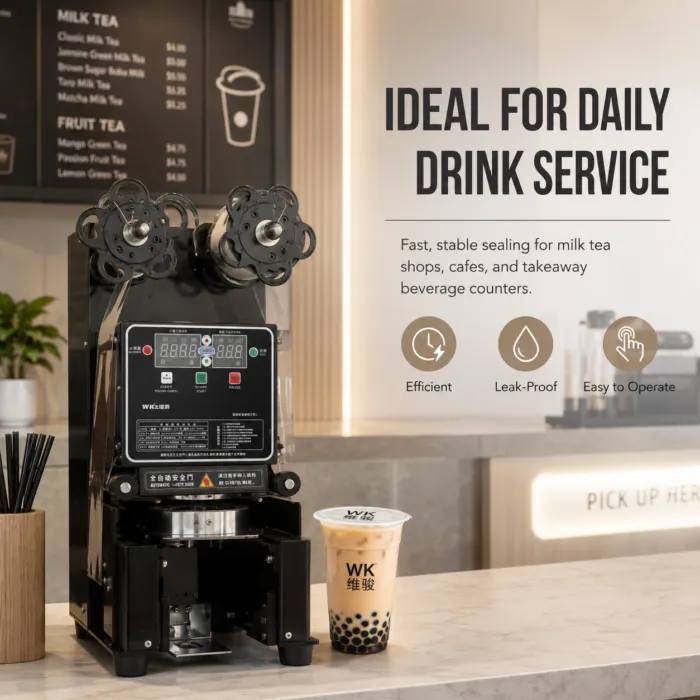
Seal takeaway cups containing milk tea, tapioca pearls, tea foam and other compatible beverage ingredients while maintaining a neat store presentation.
Automatic sealing is suitable for many iced fruit teas and flavoured tea drinks, provided the cup rim is clean before sealing.
Juice bars and beverage kiosks can use sealed cups for takeaway and delivery orders when the cup and film materials are compatible.
Cafés can use cup sealing for iced coffee, flavoured coffee and other cold drinks that require secure takeaway packaging.
The machine may also be used for compatible yogurt and dairy drink cups, subject to cup-material and film compatibility testing.
7. Commercial Automatic Cup Sealing Machine Installation
- Place the machine on a stable, level, dry and heat-resistant counter.
- Leave sufficient space above and around the machine for film installation and maintenance.
- Confirm that the local voltage matches the machine’s rated voltage.
- Use a properly grounded power outlet suitable for the machine’s power requirement.
- Install the correct cup holder and confirm that it moves freely.
- Mount the film roll in the correct direction and follow the film path shown in the manual.
- Check that the film is centred over the sealing area.
- Remove protective packaging and inspect the machine for shipping damage.
- Complete several test seals before regular commercial production.
8. How to Operate a Commercial Automatic Cup Sealing Machine
Confirm that the sealing film is installed correctly and that the cup holder matches the cups being used.
Turn on the machine and set the initial sealing temperature according to the cup and film supplier’s recommendations.
Wait until the machine reaches the selected temperature before testing the seal.
Do not overfill the drink. Wipe the rim and make sure it is clean, dry and undamaged.
Position the cup vertically and ensure it sits securely in the holder.
Activate the machine and allow the automatic cycle to finish without pulling or pushing the cup holder manually.
Check the entire cup rim for loose areas, wrinkles, burned film or incomplete cutting before serving the drink.
9. Temperature Adjustment and Test Sealing
There is no single temperature setting suitable for every cup and sealing film. The correct temperature depends on the cup material, film material, film thickness, room temperature, machine condition and production speed.
Start from the film supplier’s recommended range and test several empty or water-filled cups. Change the setting gradually and inspect every seal before beginning normal production.
| Test Result | Possible Cause | Suggested Adjustment |
|---|---|---|
| Film does not fully attach | Temperature too low, dirty rim or incompatible materials | Clean the rim, confirm compatibility and increase temperature gradually |
| Film is burned or distorted | Temperature too high or heating time excessive | Reduce temperature and test again |
| Seal is uneven on one side | Cup not centred, rim damaged or pressure uneven | Reposition the cup and inspect the holder and sealing plate |
| Film shifts during sealing | Film path misaligned or roll installed incorrectly | Reinstall and centre the film roll |
10. Commercial Automatic Cup Sealing Machine Cleaning and Maintenance
Daily cleaning helps prevent syrup residue, film fragments and moisture from affecting the cup holder, sealing plate, sensors and moving components.
- Switch off the machine and disconnect the power supply.
- Allow the sealing plate to cool before cleaning.
- Remove spilled tea, milk, syrup, foam and film scraps from the working area.
- Wipe the machine body and cup holder with a soft damp cloth.
- Keep the control panel and electrical parts dry.
- Check that the cup holder can move without obstruction.
- Inspect the sealing plate for residue or damage.
- Check the film rollers and guide parts for free movement.
- Inspect the cutting area for film buildup.
- Check switches, sensors and moving parts for abnormal operation.
- Confirm that screws and mounting parts remain secure.
- Replace worn or damaged parts before continued commercial use.
11. Commercial Automatic Cup Sealing Machine Troubleshooting
| Problem | Possible Cause | Recommended Check |
|---|---|---|
| Incomplete seal | Low temperature, dirty cup rim, incompatible film or damaged cup | Clean the rim, verify materials and adjust temperature gradually |
| Film does not feed correctly | Film roll installed incorrectly, roller obstruction or poor alignment | Reinstall the film and inspect the guide rollers |
| Printed film is not centred | Film registration or sensor setting requires adjustment | Check the film mark and sensor position according to the manual |
| Cup does not enter smoothly | Incorrect cup holder, cup deformation or obstruction | Confirm cup size and clean the holder area |
| Seal leaks during transport | Weak adhesion, rim contamination, damaged cup or overfilled drink | Reduce fill level, clean the rim and complete a leak test |
| Machine shows abnormal noise | Moving component obstruction, loose part or mechanical fault | Stop the machine, disconnect power and request inspection |
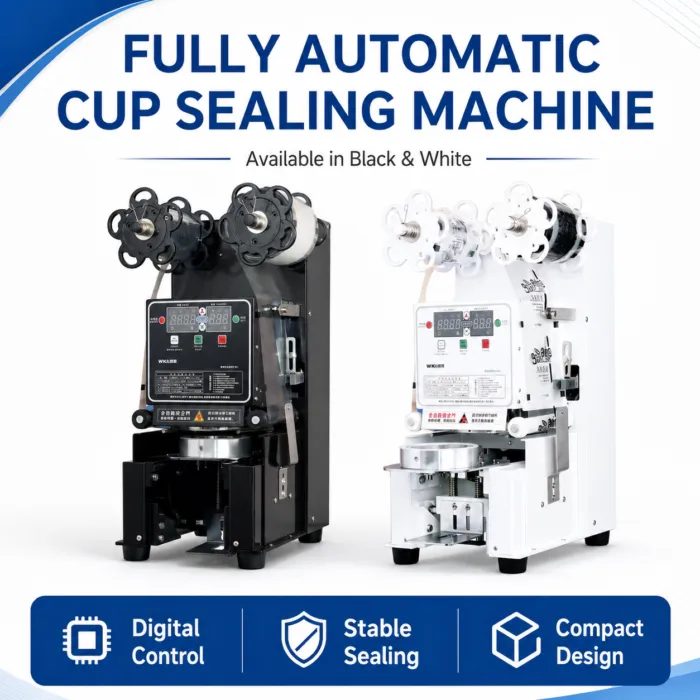
12. Black and White Colour Options
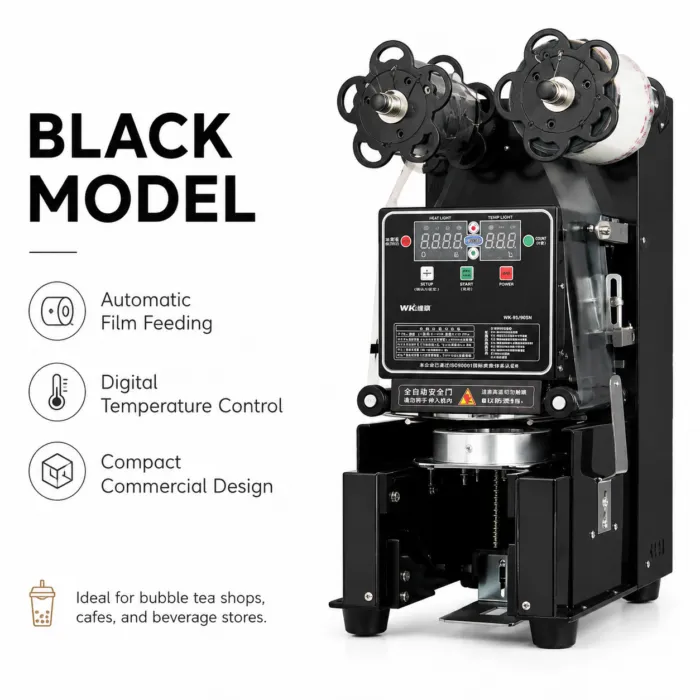
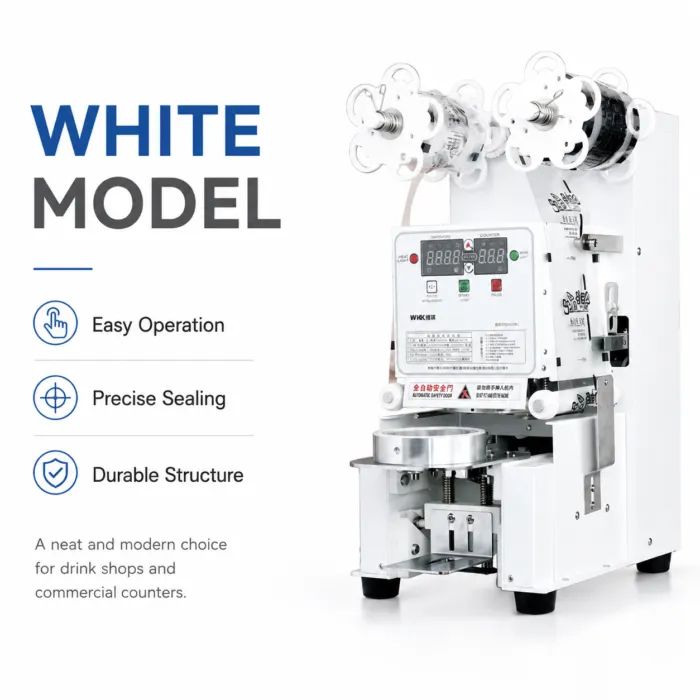
The black model offers a modern appearance that matches dark beverage counters and industrial-style cafés. The white model provides a clean, bright look suitable for light-coloured shops and open preparation areas.
13. Commercial Automatic Cup Sealing Machine FAQs
Can the machine seal every type of plastic cup?
No. Cup diameter, cup material, cup-rim shape and sealing film must be compatible with the installed holder and sealing system.
Can I use printed sealing film?
Printed film may be used when its width, material and registration marks are compatible with the machine. Sensor adjustment may be required.
Why does the film not stick to the cup?
Common causes include low temperature, incompatible materials, moisture on the rim, syrup residue, damaged cups or insufficient sealing pressure.
How should the sealing temperature be selected?
Use the film supplier’s recommended starting range and test several cups. Adjust gradually until the seal is complete without burning the film.
Can the machine be used for delivery orders?
Yes. A secure seal can help reduce accidental spills, but every cup should be inspected and tested before delivery use.
How often should the machine be cleaned?
Remove drink residue and film scraps after daily use. The sealing plate, film path, holder, sensors and moving parts should also be inspected regularly.
What should be confirmed before ordering?
Confirm voltage, plug type, cup diameter, cup height, cup material, film material, colour, order quantity, packaging and destination country.
Conclusion
A commercial automatic cup sealing machine can help bubble tea shops, milk tea stores, cafés and takeaway beverage businesses build a faster and more consistent drink-packaging workflow. Automatic film feeding, digital temperature control and automatic sealing reduce repeated manual operation during busy service periods.
Reliable results depend on correct cup and film compatibility, a clean cup rim, suitable temperature settings and regular machine maintenance. Always test the actual cups and film before regular commercial production or bulk packaging-material purchases.
Review the commercial automatic bubble tea cup sealing machine or explore more commercial milk tea equipment for your beverage store.
Request Product Details and Wholesale Pricing
Contact Foshan Weiqi Electromechanical Equipment Co., Ltd. for cup and film compatibility confirmation, voltage options, packaging information, wholesale quantities and international shipping inquiries.
Note: Product appearance, specifications and configuration may be updated. Please confirm the final cup holder, cup compatibility, voltage, plug type and sealing-film requirements before ordering.