
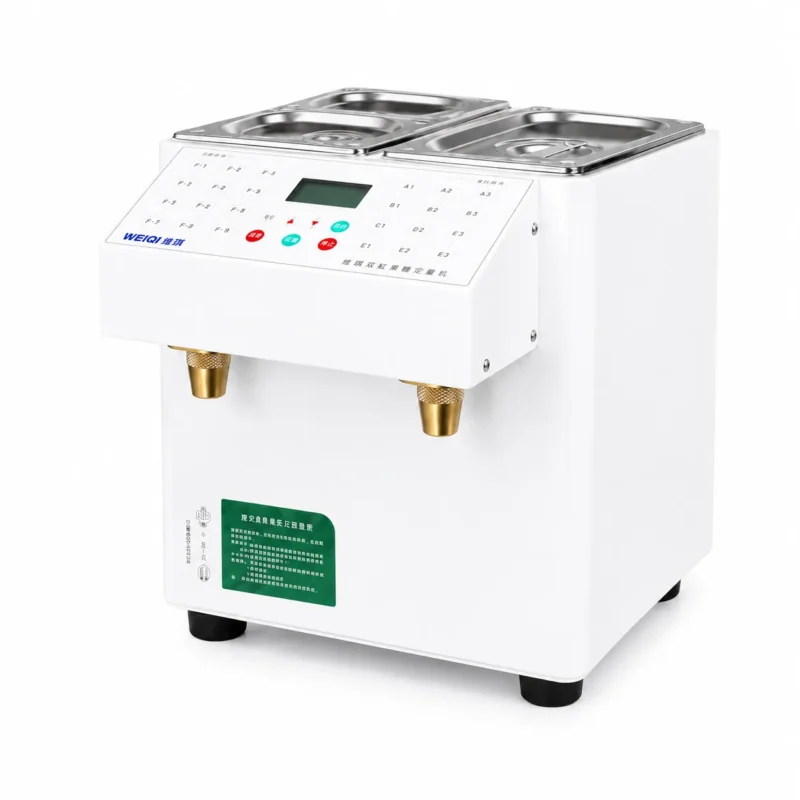
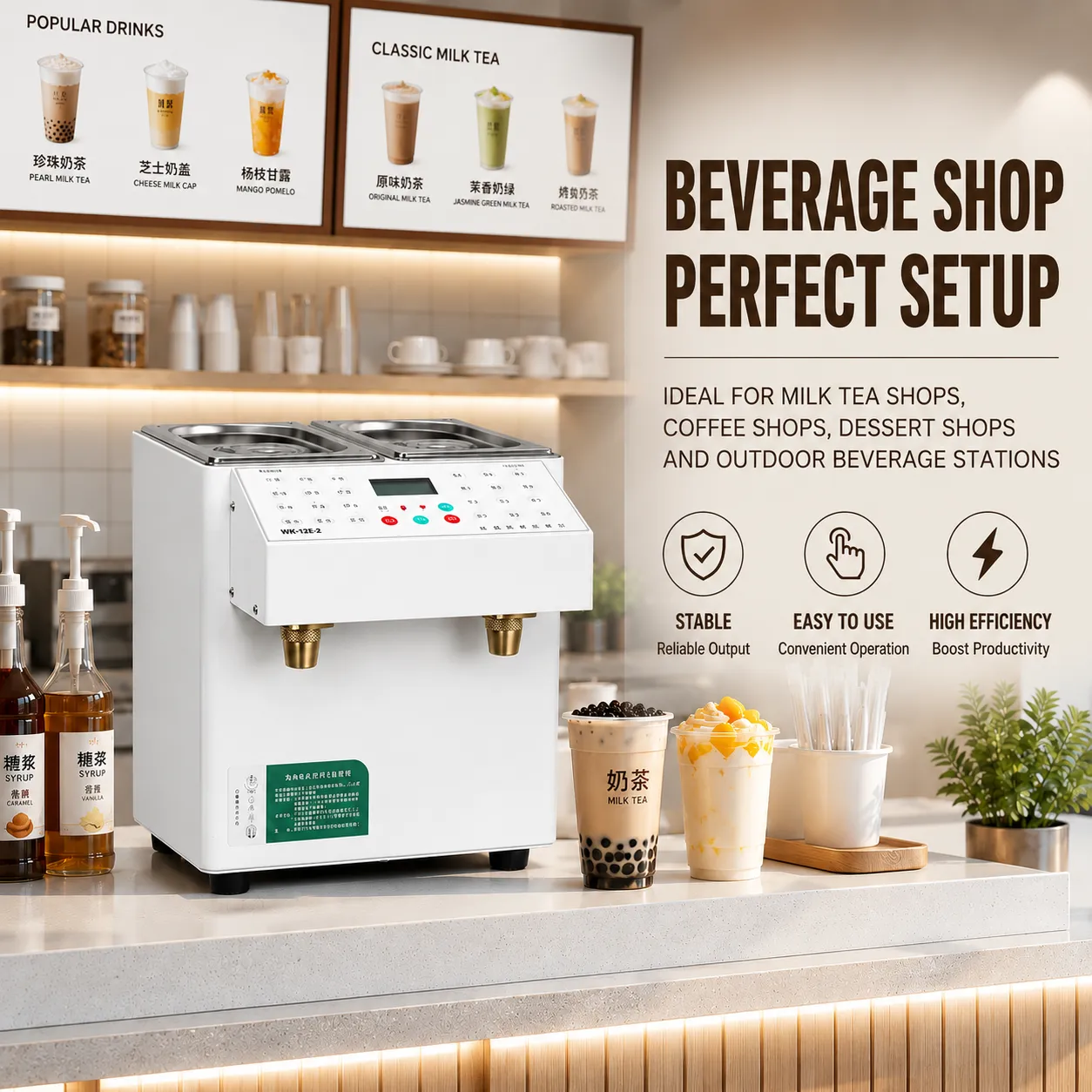
A dual-tank fructose dispenser can help a bubble tea shop standardize sweetness while keeping two liquid ingredients ready at one workstation. Instead of asking every employee to pour syrup into a measuring cup, the operator selects a preset portion and dispenses it through the assigned outlet. The result is a more repeatable recipe process, especially when several people work the same menu during a busy shift.
The machine is not a substitute for recipe development, calibration, or cleaning. Its value comes from turning a tested recipe into a repeatable operating step. This guide explains where a two-tank dispenser fits, what buyers should verify, how to plan a practical workflow, and how to maintain the syrup path without relying on unconfirmed performance claims.
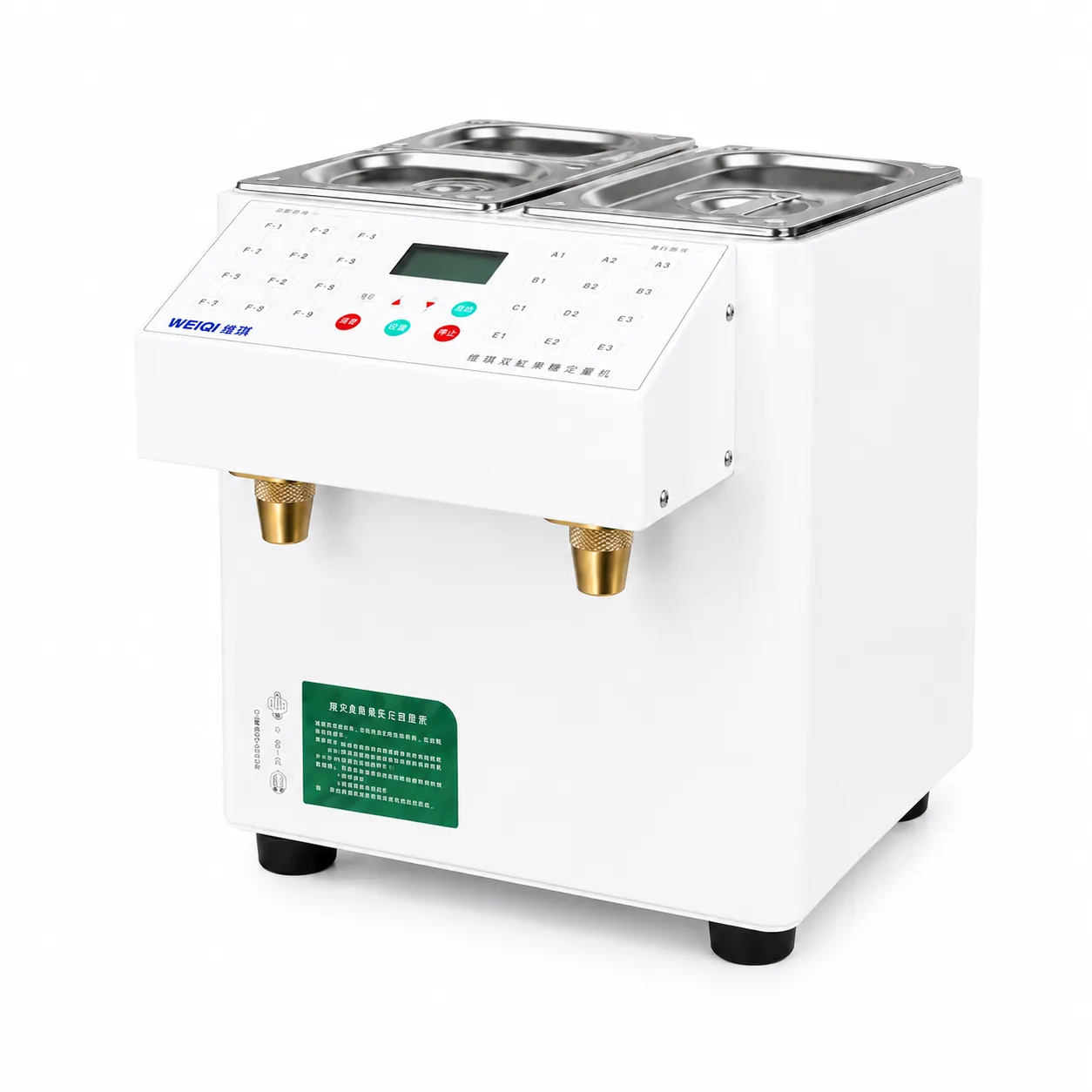
What a Dual-Tank Fructose Dispenser Does
The two independent tanks are intended to hold two suitable liquid sweeteners, flavored syrups, or other compatible beverage ingredients. Each syrup system has its own storage path and outlet, allowing a shop to keep two frequently used ingredients available without installing two separate machines. The exact ingredient must still be compatible with the machine and the supplier’s instructions.
A shop might dedicate one side to its standard fructose recipe and the other to a second syrup used in fruit tea, coffee, or seasonal drinks. Another operation may use the two sides for different menu families. The important point is to define one clear purpose for each tank, label it, and prevent staff from changing ingredients without updating the cleaning and calibration record.
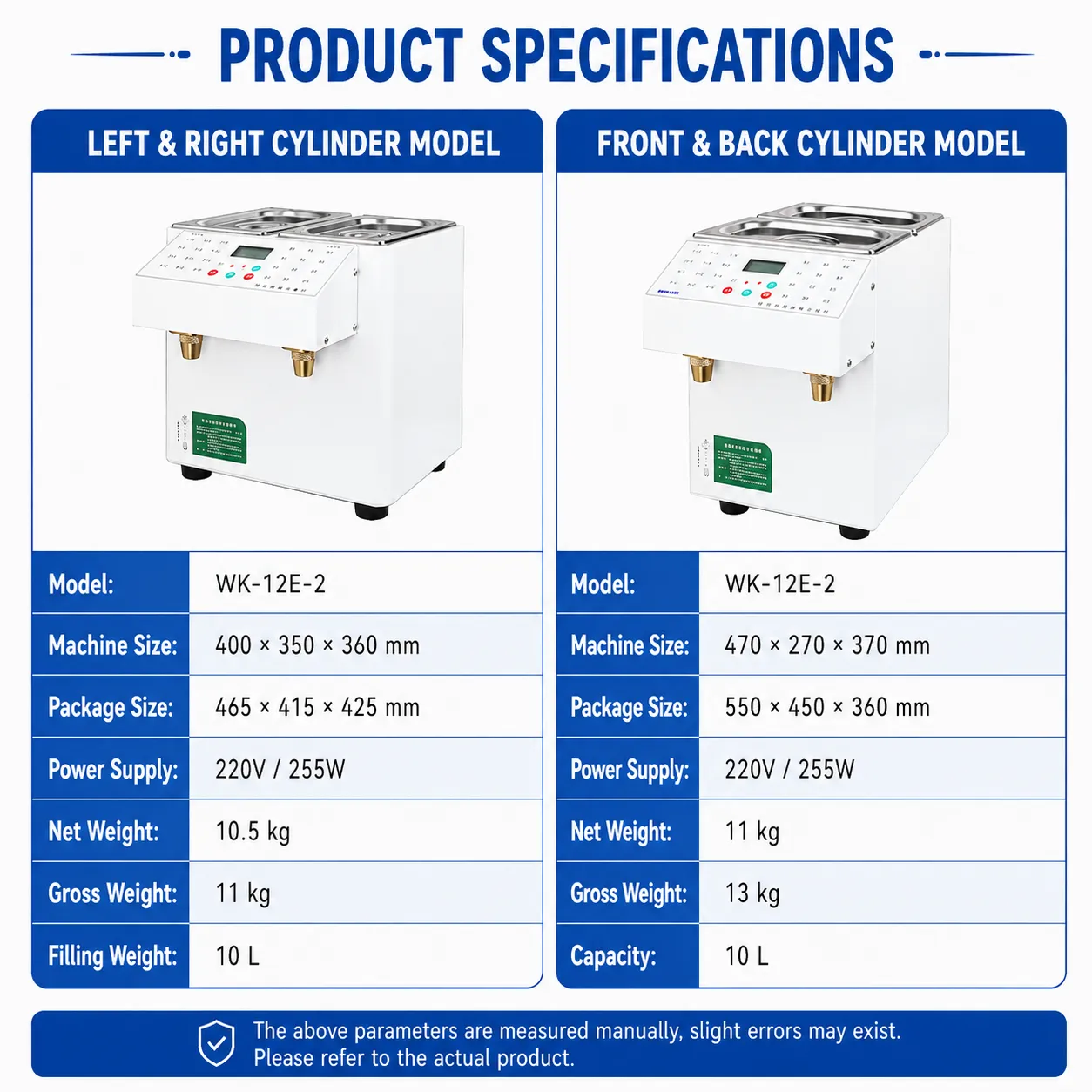
The WIKI commercial dual-tank fructose dispenser is offered in left-right and front-back tank arrangements. That choice affects counter depth, refill access, and how comfortably employees can reach the controls and outlets, so layout should be decided before ordering.
Why Beverage Shops Use a Quantitative Syrup Dispenser
How a Dual-Tank Fructose Dispenser Supports Consistent Sweetness
Manual pouring introduces variation. One employee may read a measuring cup at eye level, while another works faster and pours slightly more. A preset dispenser can reduce that variation after the shop has tested the syrup, established the portion, and confirmed the output. This is useful for stores with multiple shifts, new staff, delivery orders, or several branches following the same recipe card.
A Simpler Peak-Hour Sequence
During a rush, fewer separate measuring steps can make the drink-building sequence easier to follow. Staff still need to select the correct recipe and sweetness level, but they do not need to fetch and refill a measuring cup for every order. The practical benefit depends on counter placement: cups, tea, toppings, ice, syrup outlets, and sealing equipment should follow a logical movement path.
Clearer Ingredient Control
Fixed recipe portions make it easier to compare theoretical syrup use with actual inventory movement. This does not guarantee a specific reduction in cost, because waste also comes from spills, incorrect orders, expired ingredients, and poor stock rotation. It does, however, give managers a more consistent baseline for investigating unusual consumption.
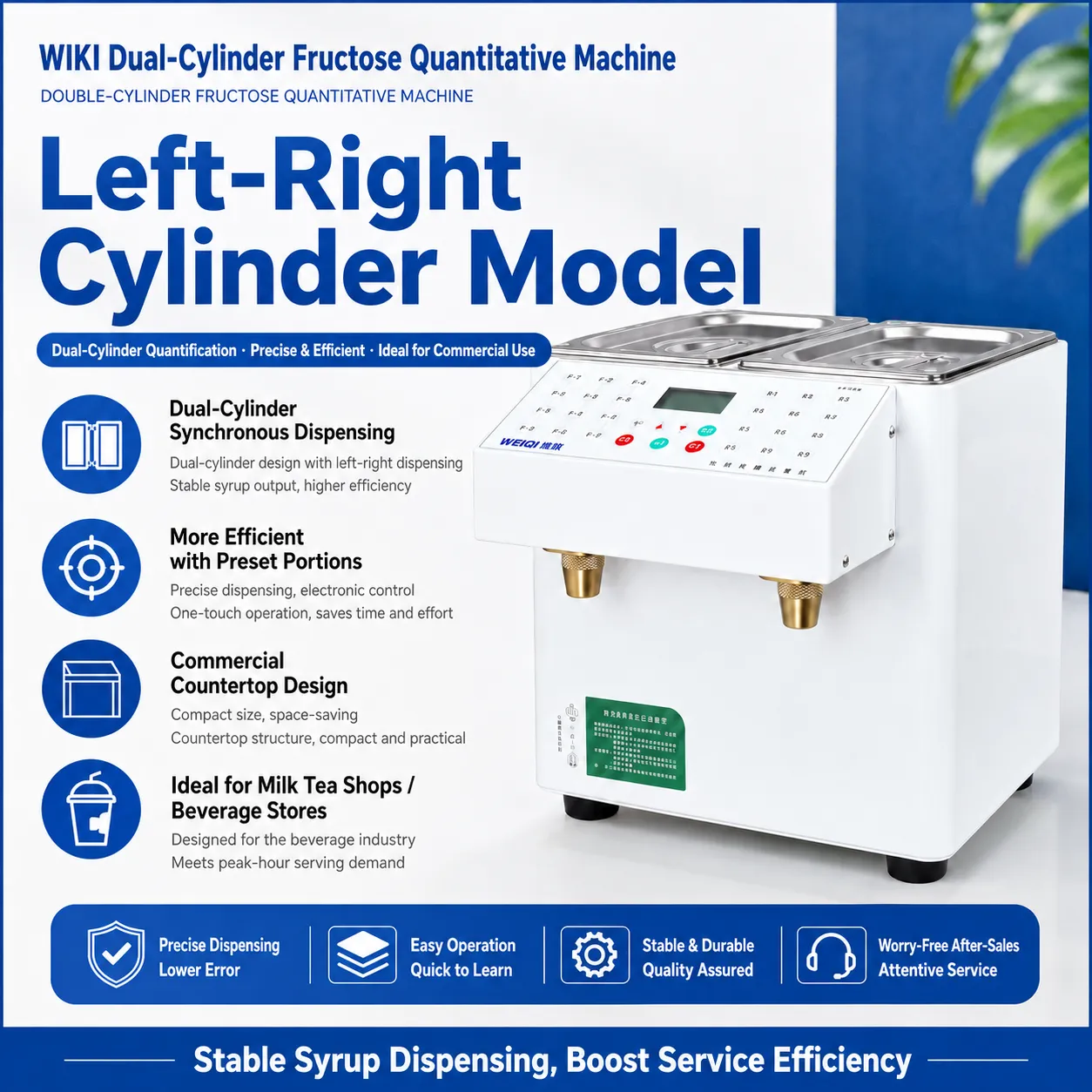
How to Choose a Dual-Tank Fructose Dispenser
Start With the Menu, Not the Machine
List the drinks that require measured syrup, their cup sizes, and the sweetness options customers can select. Count how many recipes use the same base syrup and whether a second ingredient is ordered often enough to justify a dedicated tank. If the second syrup is rarely used, the added cleaning work may outweigh the convenience.
Test Syrup Compatibility and Calibration
Syrup thickness changes with formula and temperature. A setting that works for one fructose syrup may not produce the same portion after the ingredient, supplier, or storage conditions change. Ask the equipment supplier how calibration is performed and whether your intended syrups can be tested. After installation, verify output with the shop’s own measuring procedure before putting the machine into service.
Compare Dual-Tank Fructose Dispenser Layout and Counter Access
Measure the available counter area and the clearance needed to open covers, refill tanks, remove parts, and clean around the machine. A left-right arrangement may suit a wider counter, while a front-back arrangement may suit a different footprint. Do not choose from the front view alone. Check the full product dimensions, power connection, outlet position, ventilation requirements, and service access with the supplier for the specific configuration quoted.
Confirm the Order Configuration in Writing
Before payment, request a written specification sheet for the exact model. Confirm tank arrangement, rated voltage, plug type, included accessories, packaging, production lead time, warranty terms, spare-parts availability, and after-sales contact. These details can vary by destination and order, so they should appear in the quotation or pro forma invoice rather than being assumed from a general buying guide.
Buying Checklist for a Commercial Syrup Dispenser
| Decision area | What to verify |
|---|---|
| Menu fit | Two high-use, machine-compatible liquid ingredients have been identified. |
| Recipe control | The shop has documented portions for each cup size and sweetness level. |
| Calibration | Staff know how to test output after an ingredient or temperature change. |
| Counter plan | There is room for operation, refill, cleaning, ventilation, and service. |
| Cleaning | Food-contact tanks, tubes, and outlets are accessible under the supplier’s procedure. |
| Electrical fit | Rated voltage and plug type match the installation location. |
| Commercial support | The quotation states warranty, spare parts, lead time, and shipping terms. |
Buyers planning a complete beverage line can also review the commercial milk tea equipment collection. For a comparison with a single-ingredient workflow, read the automatic fructose dispenser guide for bubble tea shops.
Dual-Tank Fructose Dispenser Setup and Daily Routine
- Assign and label each tank. Record the ingredient name and opening date according to the shop’s food-safety procedure.
- Inspect before filling. Check that the tank, tube, and outlet are clean, correctly assembled, and free from old residue.
- Fill with compatible syrup. Follow the machine instructions and avoid mixing different products in one system.
- Prime and test each side. Confirm that the correct ingredient exits the correct outlet and that the measured output matches the shop’s target.
- Use a recipe chart. Place a clear chart near the station so employees select the correct preset for cup size and sweetness level.
- Record exceptions. If output changes, stop relying on the preset until the cause has been checked and calibration has been repeated.
Train employees to treat the two outlets as separate ingredient systems. A color label or simple A/B designation can reduce mistakes. The recipe card should identify both the outlet and the selected portion, rather than depending on memory.
Cleaning a Dual-Tank Syrup Dispenser
Syrup residue is sticky and can accumulate in tanks, tubing, and outlet components. Follow the manufacturer’s cleaning instructions for the exact machine and ingredient. Disconnect power before cleaning or maintenance, keep water away from electrical parts, and do not spray the control panel or internal components.
Clean the two product paths separately to avoid flavor transfer. Use only cleaning and sanitizing methods compatible with the equipment and local food-service requirements. The FDA Food Code explains that beverage dispensing circuits and lines should be cleaned routinely to prevent residue accumulation; it also emphasizes following manufacturer guidance for equipment whose food-contact surfaces are not readily visible. Operators outside the United States should follow the rules of their own jurisdiction.
A practical maintenance log can include the ingredient in each tank, cleaning date, person responsible, calibration check, observed output, and any replacement parts. If dispensing becomes slow or inconsistent, check syrup condition, temperature, blockage, tube installation, and calibration before assuming an electrical fault. Escalate unresolved issues to the supplier rather than opening protected electrical sections.
When a Dual-Tank Fructose Dispenser Is the Right Choice
A dual-tank fructose dispenser is most useful when a shop repeatedly portions two compatible liquid ingredients and wants both available at one station. It can also suit a growing menu when the second tank supports a meaningful share of orders. A single-tank model may be simpler for a compact shop using one primary syrup, while multiple stations may be more suitable for a high-volume operation with separate production lines.
The best decision is based on order data, recipes, counter flow, and cleaning capacity. Do not buy extra tanks only for theoretical flexibility. Choose the arrangement your team can label, calibrate, clean, and use consistently every day.
Frequently Asked Questions
Can a Dual-Tank Fructose Dispenser Hold Different Syrups?
Yes, the product is designed with two independent tanks for suitable liquid sweeteners or flavor ingredients. Confirm ingredient compatibility with the supplier, keep each path clearly labeled, and clean the systems separately.
Does a preset guarantee the same output for every syrup?
No. Viscosity, temperature, formulation, tubing condition, and calibration can affect the dispensed amount. Test the actual syrup and recheck output whenever an ingredient or operating condition changes.
Which layout should a buyer choose?
Choose between the left-right and front-back arrangements after measuring the counter and checking refill, cleaning, control, and service access. Ask for the exact configuration drawing before placing the order.
How often should the syrup paths be cleaned?
Follow the equipment manufacturer’s schedule, ingredient guidance, and applicable local food-safety rules. Increase attention when residue appears, flow changes, flavors are switched, or the machine will be idle.
What should a wholesale buyer request from the supplier?
Request the exact model specification, voltage and plug, tank arrangement, included parts, packaging details, minimum order quantity, lead time, warranty, spare-parts plan, shipping options, and sample or calibration support.
Request a Dual-Tank Dispenser Quotation
Send your destination country, preferred tank arrangement, syrup types, estimated order quantity, voltage, and plug requirement. WIKI can confirm the available configuration and prepare a B2B quotation.
For email or a detailed equipment list, use the WIKI contact page.